

Where’s Progress Waldo?
By Justin Howe
10 minute read
A little introduction to this week's note from the trail.
I'm wildly curious about progress. About what actually happens when I'm working on something at the limit of my skill. I see practice, training, and action as the ways to make real progress toward excellence in anything — and I love all three. I'm eager to take on hard things that challenge what I understand as possible, to test my limits with curiosity. For me, progress follows action.
I also know that everyone reading this knows what it feels like to work harder and go nowhere. You’re working on something you care about, and somewhere along the way, the work stops giving anything back. The creativity goes quiet. You keep showing up — with the same hunger and discipline, sometimes more — and progress flatlines. No visible gains. No sign of improvement. Not because you stopped caring. The plateau doesn’t arrive because of those things. It arrives despite them. That’s what makes it the most human part of doing hard things. That’s the plateau. What do you do?
What I've come to understand is that progress never stops on a plateau. What stops is our ability to see it. That's a design problem. And design problems have solutions.
At the time of writing this, I find myself working on a limit-level bouldering project at my local gym. I can see the start and the finish. After watching two people in my climbing community send it, I can see what it takes to complete the project. This particular route, rated a V8, is limit climbing for me — hard in almost every dimension, requiring strength, technique, precision, and a high level of awareness with an understanding of the subtle nuance required for every single move that is challenging to the very end, never letting up once. I love it because each move has to be executed with both precision and efficiency, ensuring that I don't burn too many matches and have enough energy to make the final precarious moves to the finish hold.
There was a quote a mentor shared with me from George Leonard while discussing progress and plateaus:
“You also have to be willing to spend most of your time on a plateau, to keep practicing even when you seem to be getting nowhere.”
George Leonard, Mastery: The Keys to Success and Long-Term Fulfillment (1991)
George Leonard, in Mastery, reminds us that the plateau is not an obstacle to mastery. It is where mastery actually lives.
Seeing the Plateau
Progress working through each of the moves, one at a time, happened rather quickly within one session. Each section was figured out, some linked together more easily than others. All of it was hard — right at my limit. For 90 minutes, progress was easily seen, however, at the end of that session, the stark reality of the full scope of difficulty came into view. This is what it's like to see the next plateau. This single project had a plateau so flat and expansive that being a flat-earther doesn't feel all that irrational for a hot second.
There's a great section deep in The Way of Excellence by Brad Stulberg that walks through an incredibly resonant description of progress and the relationship we develop to noticing it:
“A more accurate description of progress looks like this: When you are new to an activity, you might get 100 percent better every day. As your skill increases, the gains become more incremental: 10 percent, 5 percent, 1 percent, half a percent, a quarter of a percent, and so on. Eventually, improvement becomes so small you can't even perceive it. At this point, you might find yourself on a plateau for a few days, weeks, or maybe even months. Then suddenly, perhaps when you are least expecting it, you experience a breakthrough.”
Brad Stulberg, The Way of Excellence, 2026.
Progress on the Plateau
In the early stages, progress is loud. You see and feel it between sessions. If you have others around, they can see it. But as progress continues and skill rises, the gains don't disappear — they shift. What once showed up in big visible improvements begins to live in smaller things: a moment of awareness, a subtle shift in body position that makes the transition to the next move just a little smoother while using less energy, a clearer view on a crucial change of pace and timing flowing from one section that requires powerful moves to the next one that requires delicate strength with precise slow balance that wasn't there before.
Awareness and understanding start arriving in small, subtle ways — in nuances. Strengths are quietly building in small ways, often too small to recognize because they're in tiny fractions of a percent. Others watching you work a project over and over again, failing at the same or different spots, rarely notice the progress.
On the plateau, progress without completion requires a willingness to look for something that does not announce itself, and the capacity to search with curiosity and precision when there is no obvious reward for finding it.
That kind of sustained focus is hard. Little to no self-generating momentum, little to no recognizable progress — it demands something the early stages never required: the willingness to practice for the less than 1% gains in strength, awareness, understanding, not for the visible win. All with the belief that enough consistency will compound and you'll make a breakthrough to complete the project.
Intelligent Failures
There is something else happening on the plateau alongside the invisible progress: visible failures. The attempt that doesn't go. The same move that slipped before that slips again. The sequence that almost links and doesn't. These feel nothing like invisible progress. They feel like empirical evidence of being stuck.
Amy Edmondson — Harvard Business School professor and author of The Right Kind of Wrong — offers a reframe. She describes the search for progress as something like navigating a dark room:
“Each stab in the dark might not give you the door handle, but it tells you where the door handle is not.”
Amy Edmondson, Hidden Brain: “Making the Most of Your Mistakes,” August 3, 2026.
Every fall, every attempt that doesn't connect, every move that reveals a new problem — these are what Edmondson calls intelligent failures. Not setbacks to progress. Discoveries. The systematic elimination of what doesn't work is the only path to what does. The plateau doesn't just hide progress. It produces it — through the attempts, and through the falls.
The problem is that the mental model built at the start of the project has no frame for any of this — not the invisible gains, not the intelligent failures. It was designed for something entirely different.
Mental Model Goggles on the Spot
At the beginning of a new endeavor or project, it feels like the brain builds a set of mental model goggles on the spot — constructed from the lived experience of doing it. Calibrated to easily see, feel, and recognize big progress. It also comes with a built-in fuel system: motivation, delivered by the big progress itself.
These become the goggles through which you see, feel, and measure everything about this project. Ultimately, without familiar seen and felt progress from the goggles made on the spot, that motivational fuel slows to a drip. Sometimes it stops altogether. Resistance and a whole crowd of other things start showing up in place of the big things the goggles were made for seeing.
So, as skill level rises, progress seemingly disappears on the plateau and new things start showing up — frustration and resistance. What we need is a new set of mental model goggles designed and calibrated to seeing progress on the plateau.
Incomplete Completion
The plateau goes deeper for leaders — because in leadership, it doesn’t just feel different. It’s structured differently. And in the fastest-moving product creation environments, it takes a form that changes what “stuck” even means. It doesn’t look like stagnation. It looks like the Black Knight scene from Monty Python and the Holy Grail: King Arthur removing limb after limb from the Black Knight, kneeling to thank God for the victory — only to be kicked in the head by the now-armless knight still insisting “it’s just a flesh wound.” Every measurable marker of victory achieved by King Arthur. And the last word from the limbless, grounded knight? “All right, we’ll call it a draw.” Completion keeps happening. The feeling after always calls it a draw.
There’s a name for that feeling. Call it the incomplete completion paradox. Completion happens — products launch, objectives are met — but the felt experience of arriving never does. The next brief is already running before you’ve processed the last one. The milestone is achieved; the psychological landing isn’t.
This is the treadmill. There is always a next brief, a next objective, a next version. The 2-year plan lays out the pace. When new competitors take market share or the marketplace experiences a phase of rapid intensification, the pace is cranked up to a sprint. In that environment, the mental model goggles built to see milestone-to-milestone progress become a trap. The goal line keeps moving.
But the deeper problem isn’t the pace. It’s the lens. A mental model calibrated for milestones — built to detect launches, deliverables, objectives met — is structurally unable to register what’s actually compounding beneath the surface. W. Edwards Deming called this out directly:
“It is wrong to suppose that if you can’t measure it, you can’t manage it — a costly myth.”
W. Edwards Deming, The New Economics for Industry, Government and Education (1993).
The inverse is equally true: if the mental model isn’t designed to register something, it simply can’t measure it. And detecting the small things — the quiet accumulations of growth, learning, and creative progress that compound through the relationship with the work itself — requires a different, complementary lens. Not a replacement for milestone thinking. A second one, calibrated for what the first one can’t see.
Good leaders pay close attention. But they’re often looking through a lens designed for something else entirely. That lens cannot see the creative judgment accumulating through iteration, the capability building in the sustained relationship between a leader and their craft, or the learning that shows up quietly, over time, in the quality of the thinking and the work. Even with full focus and genuine commitment, what’s growing stays invisible. This is exactly how the plateau feels — not because progress has stopped, but because the instrument being used to measure it can’t detect what’s accumulating.
When that second lens is active — calibrated not for milestone arrivals but for the small, quiet evidence of growth that lives in the process — what was invisible becomes the measure. Collins puts the flywheel on it:
“Good to great comes about by a cumulative process — step by step, action by action, decision by decision, turn by turn of the flywheel — that adds up to sustained and spectacular results.”
Jim Collins, Good to Great (2001).
The process isn’t the path to the outcome. It is the outcome.
The Context and Community
Changing the mental model, especially under pressure, feels like a risky move for leaders, and even more so for the teams they lead. New mental models require emotional agility and psychological safety as a prerequisite. Without it, no real change at the thinking level can take root.
Edmondson draws a crucial distinction:
“Psychological safety is not a personality difference but rather a feature of the workplace that leaders can and must help create.”
Amy C. Edmondson, The Fearless Organization: Creating Psychological Safety in the Workplace for Learning, Innovation, and Growth (Wiley, 2018).
That distinction matters. The conditions for safety — the permission to experiment, the freedom to fail intelligently, the supportive community to do it in — don't come from any individual's temperament. They come from the environment leaders build. Creating those conditions is not separate from the work of changing how a team sees and thinks. It is where the work begins.
I know this because over decades of failing and learning, I discovered and designed a mental model tool that does exactly that — shifting what the goggles see when things get hard and progress feels impossible to find on the plateau.
To redesign the mental model goggles to support a fun experience on the plateau, I turn to my 9-year-old for inspiration, because if a 9-year-old finds it fun, it's got to be simple.
Where's Waldo?
One of my kids' favorite childhood books showed me exactly what to calibrate the second lens for. Where's Waldo? helped me to think of small hidden bits of progress as a little person, just like Waldo. Tiny and hard to see, obscured by all kinds of challenging things on the project scene.
So, when you find yourself on a plateau — when progress has seemingly disappeared and resistance and frustration are building without a clear source — ask yourself:
Where's Progress Waldo?
Progress Waldo is there. He's there on the beach, in the mountains on the ski slopes, in the town square and at the wall. He's not trying to hide — he's crowded out by the hard work, the failure, the frustration and agitation that fill the scene.
What makes him tricky is this: he doesn't wear a red and white striped hat. He's constantly changing his wardrobe from one page to the next, so the mental model built early in the project — looking for him in the same places, expecting the same outfit — comes up empty.
Instead of there being just one Progress Waldo per page, Progress Waldo can show up multiple times in the same scene. So, to find Progress Waldo, you need to shift what you're looking for.
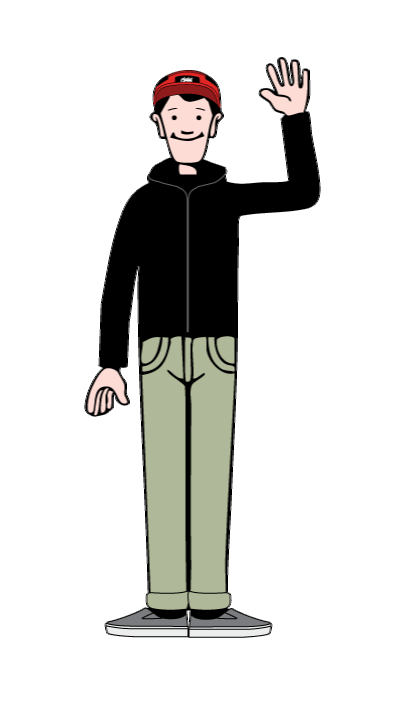
I make it into a game where I imagine I have a bunch of classic Ciele running caps in my backpack, and as I find a Progress Waldo, I pop a cap on his head and imagine him raising his hand in the air and waving it to say thanks, blinking his eyes and smiling that he's been found, and that he loves his new cap.
This little method helps me notice him more consistently and enjoy the search as the hard work continues. Regardless of when progress or a breakthrough is made, asking 'Where's Progress Waldo?' ensures the process is rewarding.
Over time this approach has become such a regular practice that I often notice Progress Waldo a day or two later, at random times when I'm focused on something else. Almost as if he's been given time and space to emerge from the crowd to be seen.
The Process is the Reward
The Waldo game is that second lens in practice — designed simply, trained through the search, until the process itself starts waving back. Psychologist Mihaly Csikszentmihalyi spent decades studying exactly what happens when it does. He called it flow. What he found at the heart of it he named the autotelic experience — an activity done for its own sake, where the doing is the reward.
People who could access this state were not less driven by results. They were more deeply engaged, motivated by something outcomes could not supply or take away.
The Waldo game is an intentionally designed autotelic tool. It shifts the reward from the destination to the search. A little playful joy in the hard work, no big visible progress required.
Progress Waldo is there. He always has been. He just needs a cap.
This started with a question: when the work stops giving anything back — what do you do? The answer isn't to push harder or wait it out. It's to change what you're looking for.
Your Progress Waldo might not look like mine. Maybe yours is a Progress Wenda, or a Progress Wendell. Whoever they are, they're out there waiting.
Here's a good place to start: What are they wearing? Where do you tend to find them? And when you do — what do you do to let them know they've been seen, and make them smile?
It's great to have you here, my friend. I look forward to next time.
Peace be with you.
-- Justin
Justin Howe is the founder of Trailyst, an executive leadership coaching and consulting practice. If this piece resonated, you can read more at trailyst.com or book an exploratory conversation.